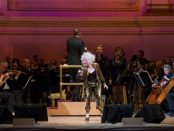
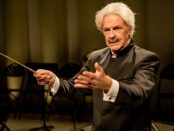
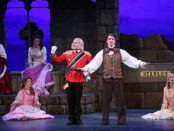
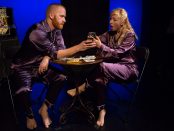
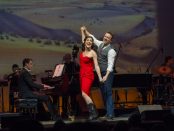
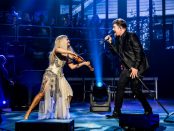
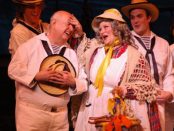
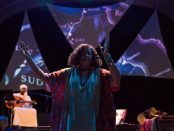
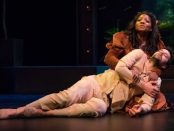
"Kinky Boots" ’ uplifting finale "Raise You Up/Just Be" was a euphoric highlight of The New York Pops’ marvelous tribute concert "Hat Full Of Stars: The Songs Of Cyndi Lauper. " The 2013 Tony Award winner for Best Score and Best Musical’s original cast member Stark Sands was joined by Lena Hall, Alex Newell, the Camp Broadway Kids ensemble and the renowned 78-piece orchestra. Earlier, that long-running Broadway show was represented by the limber and magnetic Mr. Sands’ dazzling "The Soul of a Man" and the "Glee" star Mr. Newell’s soulful "Hold Me in Your Heart." [more]
With the medley of “My Romance” and “My Funny Valentine,” he warmed up and came to a gentle boil with the two songs from "Baby": “At Night She Comes Home to Me” and “With You,” both by Richard Maltby, Jr. and David Shire. Even without knowing how the songs fit into this moving show, it was obvious from the change in Vidnovic’s features that he identified with both the meaning of the words and the meaning of these songs in his life. [more]
Tony Award-winning choreographer Christopher Gattelli’s direction melded the performers with expert physical placement sprinkled with occasional dance bits that made for lively presentation. The event’s visual verve was amplified by the imaginative projection design by Dan Scully. In addition to illustrative images there were projections of Sondheim’s handwritten and typed lyrics as well as stylized photographic views. These were all continually shown on the auditorium’s back wall, beautifully complementing the performers and the speakers. [more]
The evening’s vocal guests are exceptionally strong singers, although their talents are not equally evident in a concert format. Silverman probably shines best in a book show, as well as Osnes, although she did demonstrate more spontaneity and connection with the audience. Kilgore brought even more freedom, energy and levity, and Large’s vocal and physical presence was sheer dynamite, and never to the detriment of ensemble moments. The amazing caliber of The New York Pops itself cannot escape mention; its underscoring of each of the singers was exquisite. Their ad hoc dedication to the late Michel Legrand and Andre Previn with a superb “The Summer Knows” (Michel Legrand/Marilyn and Alan Bergman, The Summer of ‘42, 1971) and the second act opener Disney Classics Overture were wonderful moments featuring its amazing musicians. [more]
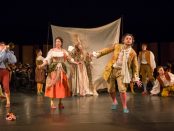
Unlike the company’s 2016 luxuriously staged "Les Fêtes Vénitiennes," also at the Gilman, "Rameau" was purposely staged by Sophie Daneman as if in a village square, simply but effectively, the “effects” improvised as only peasants would: entrances to temples and heaven were curtains stretched between two poles; Jupiter appeared in a high stage box as an improvised Mount Olympus; a dancer as a god glided bare-chested undetected amongst the celebrating peasantry. According to the program, this type of performance is called “théâtre de la foire” (theater of the fair). [more]
"We’ll Have Manhattan: Rodgers & Hart in New York," created and narrated by the soon-to-become Broadway’s Tootsie (in the new Broadway musical), Santino Fontana found most of its emotional heft in the sad story of the partnership of the efficient Richard Rodgers and the foot-dragging Lorenz Hart who found himself, a not handsome gay man, in the wrong time and place. Hart had little personal happiness, it seems, but his songs were certainly full of gaiety and wit. [more]
“Emmenez Moi” was the stirring opening number performed by the French Ms. Constant as she majestically strode through Don’t Tell Mama’s cabaret room and onto the small stage. With her expressive enchanting singing, engaging playful presence, upswept flowing blonde hair and clad in a slinky glittering black sequined dress, Ms. Constant was a vision of star quality. [more]
Eve Wolf’s play is essentially a monodrama, with John Noble portraying the title character. The production is a rich one, both visually and aurally. It features an abundance of live music, performed by a vivacious string quartet (violinists Mari Lee and Henry Wang, violist Matthew Cohen, and cellist Ari Evan), along with a pianist (Zhenni Li) and a trumpeter (Maximilian Morel). In addition, excerpts from historical recordings are heard. Meanwhile, extensive animated projections from designer David Bengali become central to the overall effect. The play is a kaleidoscopic, sense-stimulating experience that seems at times just to avoid becoming a three-ring circus. [more]
In the plus column, it was easy on the eyes. Scenic designer Lou Anne Gilleland created agreeable though not particularly elaborate sets: a rocky stretch of seashore for the first act and a gloomy ruined chapel for the second. Lighting designer Benjamin Weill gave us a kaleidoscope sky that turned lavender or red or some other dramatic shade, according to the changing moods of the story. And Gail J. Wofford and Quinto Ott’s costumes were bright and playful, especially the flouncy sleepwear (Queen Victoria’s Secret?) worn by the female wards of Major General Stanley, the operetta’s famed “Modern Major General.” [more]
Except for “Santa Baby” and “The Little Drummer Boy,” virtually every Christmas song in existence is wonderfully performed during the pleasant holiday extravaganza, Ruben & Clay's Christmas Show (aka Ruben & Clay’s First Annual Christmas Carol Family Fun Pageant Spectacular Reunion Show). Even the now controversial "Baby, It's Cold Outside" is heard though revised lyrics. [more]
Though vastly different from each other, all four operas dealt either directly or indirectly with time, with the ways in which the past -- personal, historical, mythic -- influences the present. Each work, though short, provided a compelling immersion in a very particular and individual moment. [more]
Pink’s “Perfect” was the exhilarating finale of singer Christopher Caswell’s vivacious cabaret act, "Step into the Sun." Fourteen eclectic, mostly unconventional numbers were performed in 75 easygoing minutes with depth, humor and virtuosity. Interspersed with the musical portions was his expertly crafted biographical patter delivered with skillful comic timing and emotional resonance. It all added up to an entertaining theatrical self-portrait. [more]
The New York Theatre Ballet performed the lovely, all-female, “Come to Me, Bend to Me” from that musical, a sweet look at pre-wedding preparations in the ancient village of Brigadoon. That troupe began with two excerpts from de Mille’s groundbreaking “Dream Ballet” from "Oklahoma!" and her “Hornpipe” from another Rodgers and Hammerstein classic, "Carousel" (1945), its fishermen bouncing about while on the hunt for female companionship. [more]
The whole evening was an experience of two interconnected worlds. The first was the historical world of Dadaism, exhibited in music, words and visual images. The second was Livingston’s dexterous and inspiring explication of that first world’s coherence. For both experts in Dadaism and newcomers to that important moment between the two world wars, Livingston’s presentation captured the essence of Dadaist artists’ experiments and assertions. [more]
As for cast standouts, Greenwood excelled both musically and dramatically. His ringing, expressive vocals and crisp diction made him an audience favorite. And he created an effective character shift when the assertive and seemingly self-adoring Fairfax shaves his beard to become a rather diffident novice yeoman. Another notable turn came from David Auxier as the austere, thoughtful Sir Richard Cholmondeley, the Tower lieutenant. (Auxier also served as choreographer, providing a few athletic dance moves of the sort not always seen in Gilbert & Sullivan productions.) In terms of musicality, Benke’s Phoebe had a warm, winning, almost musical-theater sound, while Watson Chase prompted goose bumps with her vibrant top notes. The production’s orchestra sounded rich and full from overture to Act II finale. [more]
Each song – some traditional folk ballads and some national calls to history and identity – became, in Aynur’s hands, an individual work of art, intricately structured and elegantly paced. Aynur combined subtle artistry with intimate, fresh connection to both her colleague musicians and her audience. Singing in Kurdish and seamlessly incorporating Western contemporary motifs, Aynur conveyed accounts of human events – hope and fear, joy and grief, wisdom, innocence, experiment and embrace – that were clear and compelling, even for audience members who couldn’t understand her words. [more]
Nally’s extensive program notes provided insights on the program, whose title comes from the opening line of Virgil’s "Aeneid," “Arma virumque cano” … “I sing of arms and the man.” Nally juxtaposes the Roman epic with Lawrence Ferlinghetti’s 1976 “call to poets” and notes the presence of rage as a human impulse that links Aeneas’ war stories with the contemporary United States. Various choral pieces in the program by contemporary composers as diverse as David Lang, Gabriel Jackson, Suzanne Giraud and Sebastian Currier addressed themes such as grief, awe, reverence, hope and anger. The pieces were typically a cappella, but three marvelous cellists – Alexander Hersh, Arlen Hlusko and Thomas Mesa – provided linking music between works. [more]
Stranger still is the choice of Angelica Page to play Dickinson who looks rather too healthy to be the famously thin and sallow-faced writer known from the one famous photograph. She makes Dickinson sarcastic, arrogant, cynical, self-important and haughty which goes against the voice of the woman in the poems. At times she has been given arty stage directions like posing by a mantelpiece or sleeping on the ground next to what we assume is alongside of her father’s grave. [more]
Holbrook’s enduring youthful presence, twinkling charm and commanding vocal authority make him the ideal vessel to channel Lerner’s monumental achievements. Through his concisely informative commentary that is perfectly interlaced with 25 songs, we learn Lerner’s biographical essence. Wit, Harvard, Broadway, Hollywood, eight marriages, triumphs, flops and death at the age of 67 in 1986 are all crisply detailed during 80 fast-paced minutes. The presentation is a model of the tributary concert with its wide-ranging array of rarities, never before heard selections in addition to classics. The dramatic lighting and polished sound design coordinated by Rocky Noel added to the show’s depth. [more]
The Festival’s sole lecture-presentation proved useful in revealing how one composer viewed the intersections of science and art in his own composing: trumpeter Skye van Duuren, now a trumpeter and PhD candidate in Composition in the College-Conservatory at the University of Cincinnati spoke on “Bridging Worlds: Creating Fixed Media Microtonal Music with Acoustic Instruments” and then presented the third movement of his Manifestations. Emphasizing the development of his “microtonal language … with traditional chromatic scale as a baseline … and gradations of 5 cents in octaves that each have 240 ‘notes,’ van Duuren discussed the use of Melodyne software to increase the microtones of acoustic instruments. [more]
In the very first concert, one of the finest – and also longest – pieces of the Festival was Marie-Helene Bernard’s BOA Sr (1.5, i.e. Concert 1, piece 5). In 2010, Bernard read the obituary of an old woman living in the Andaman Archipelago in the Bay of Bengal; she was the last person alive to speak the Bo language, and at the end of her life, with no one left to talk to, she spoke to the birds. This fixed media requiem piece uses fragments of an anthropologist’s recordings of the old woman’s voice with electronic musical sounds. From its beginning, this work evokes the past by preserving the voices of its ghosts; humanness is stretched out into something cosmically airy. It is a mysterious and gorgeous work, a modern anthropological moment turned into a myth of simultaneous loss and eternity. [more]
This year, the Festival site was the Abrons Arts Center; the three performance venues in the facility – the Experimental Theater, the Playhouse and the Underground Theater – were all used. In the spacious Center, performers, composers and audience socialized and exchanged ideas and personal news throughout the week. Though the Festival composers came from many countries all over the world, the “community” of electroacoustic music is quite small; performers often know each other and each others’colleagues and friends, knowledgeable audiences and strong supporters … an exceptionally eclectic and vibrant group, all interested in music that both affirms and expands the core questions about music that composers, performers and listeners have been exploring for centuries. [more]
After intermission, German-born and now San Francisco based conductor Christian Reif led the International Contemporary Ensemble together with Quince Vocal Ensemble (Amanda DeBoer Bartlett/soprano, Liz Pearse/soprano and Kayleigh Butcher/mezzo-soprano – in a first-rate performance of John Adams’ 1982 "Grand Pianola Music." This expansive, generously accessible and affirming work was conducted with comprehensive control and artistic integrity by Reif; the organic, clean connection between the conductor and the musicians elicited rich feeling and nuance from Adams’ music. [more]
One special feature of this concert was also a mark of C4’s maturity and clout as a musical organization with a well-deserved reputation for excellence: they sponsor the IGNITE commissioning competition. In the 2017-2018 season, C4 received over 300 submissions; from these, 20 finalists were chosen, and from these, three winners were chosen. C4 member Martha Sullivan wrote about the selection process in the typically informative program notes. “Tonight, after careful rehearsal, we share the winners … They showed us works they had already created, and we responded by asking each composer to create something new, something that would be born here and now, with C4 and you are privileged to witness this birth.” [more]
Part of 59E59’s Brits Off-Broadway 2018 festival, Jessica Walker’s "All I Want is One Night" takes place in an odd combination of cabaret and antique shop. Theater B in the 59E59 Theaters complex has been done over as an intimate café with moody lighting by Kate Ashton and extraordinary period perfect costumes (uncredited). It is 1980 in Haut de Cagnes and Suzy Solidor (Walker) in her dotage is about to be painted by Lindstrom (Alexandra Mathie who plays multiple characters in Solidor’s life quite convincingly) and is being cared for by a much younger lady, Giselle (Rachel Austin who also plays Daisy, later in the play). [more]
Opdam’s de Raaff playing, in contrast, was marvelous. The composer took his inspiration from Willem de Kooning’s 1977 painting, "North Atlantic Light." De Raaff and Opdam both captured the drama and movement of both white spaces and high-energy brush strokes in de Kooning’s painting. The inclusion of a tossed-about boat in the center of the painting evokes a sense of floating in simultaneous, coexisting, sea-and-sky pairings; in the middle of de Raaff’s 14-minute piece, a gentle central section of quasi-contemplative calm summoned up the feel of the boat’s suspension. [more]
Artistic director, writer, arranger and host David Loud was at lectern off to the side onstage and passionately delivered his erudite and informative commentary at length. Mr. Loud grew up with musical theater aficionado parents and he was raised with devotion to the form and he fondly reminisced about them. His mother’s favorite show was "Where's Charley?" and his father’s was "Guys and Dolls." [more]
The letters alternate with the musical portions played by Ji on piano, Ari Evan on cello and Stephanie Zyzak on violin in various combinations which are beautiful but it is never clear in what way the selections relate to Madame von Meck except for the Piano Trio in A minor, op. 50, which Tchaikovsky reveals at the beginning of the second act that he is writing for her. It is not stated whether the two excerpts from The Nutcracker, for violin and piano, and for solo piano were created for her. [more]
While "Brokeback Mountain" impresses in its sincerity, it does not move which is a serious problem considering the romantic and tragic plot. Director Jacopo Spirei’s cast is in fine form as singers though the music and its libretto fail to fulfill this story’s potential. Daniel Okulitch and Glenn Seven Allen as the two doomed lovers make indelible impressions of men in a repressed society which does not allow them freedom of expression - even though they are not given the kind of music that can move the heart to tears. Brokeback Mountain which is fine as far as it goes offers the same disappointment of many new modern operas in that its writing falls short of its high-reaching intentions. [more]
The nine pieces on this program differed tremendously from each other in style, tone and effect. However, two important qualities unified all the performances. First, the composers all caused their music to emerge from their chosen texts: they did not impose sound arbitrarily unto the words. The organic coherence of word and musical sound resulted from both the composers’ innate gifts and their consummate skill. Competent choral composition is difficult; really successful choral compositions are very rare. Second, the music was superbly performed: not merely does C4 sing well, but because the C4 singers are all themselves composers, they inhabit each work’s intentions with particularly keen intelligence. [more]
Tagaq makes music with her whole body: it is an act as fundamental as consuming, excreting, orgasm and birthing. She can make any sound – whisper and howl, caress, growl and grunt – and use it to summon, condemn, invoke or bless. Tagaq’s fellow musicians stretch out their own instruments and created sounds to meet hers in developing a constantly changing, expanding music-world. [more]
The program opened and closed with pieces for all five musicians together. Heinrich Ignaz Franz Biber (1644-1704) and Johann Heinrich Schmelzer (1620/23-1680) both made the quartet of stringed instruments and the harpsichord into a coherent unit, even as the harpsichord is so much less loud. It is as though the harpsichord provides a ground on which the string instruments provide alternately close and extended stitched lines. [more]
However, it’s not what we normally think of as an opera. And the performance, characterized by both moving strengths and disconcerting weaknesses, unfolded, awkwardly and interestingly … and then, at the end, quite powerfully … as a not-opera. Typically, operas’ drama lies in their plots; as audiences, when we’re moved, it’s because we’ve witnessed something dramatic. But in this performance of Kotik’s "Master-Pieces," the dynamic and moving intensity of the work’s conclusion lay in the fact that the work’s fundamental plotlessness – the libretto is essentially a series of poetic extractions from a 1936 lecture on aesthetics, ontology and existentialism – was transformed into a very personal drama in which the audience cannot avoid a shift from witness to participation. [more]
Brown called his concert, "If Not Now …?" implying, for himself and us, then, when? Removed by more than a decade from the kinds of composing in which he’s now typically engaged, the pieces presented in this concert were fondly remembered by some members of the audience – Brown’s friends and colleagues of long standing – and greeted with delight by other listeners who’d never heard them before. Whether or not Brown returns to composing either non-choral chamber music or more lengthy pieces such as those performed in this concert, the evening was a happy occasion to hear music that’s been unheard for many years. [more]
Angela Lansbury’s electrifying surprise appearance was the grandest of the many highlights of the New York Pops’ sensational 35th Birthday Gala, "Part of His World: The Songs of Alan Menken." The 92-year-old Ms. Lansbury performed a ravishing rendition of “Beauty and the Beast” in all its tender glory. [more]
As a composer, Rzewski is no doubt best known for his astonishing 1975 piano work, "The People United Will Never Be Defeated." It will take another century of listening and assessment to know for sure whether comparisons made between "The People United" on the one hand and Bach’s "Goldberg Variations" and Beethoven’s "Diabelli Variations" on the other will maintain their legitimacy. This Composer Portrait concert won’t solve the historical piano quandary: this evening excluded piano music, focusing instead on two string quartets, the first dating from the composer’s adolescence and the second from just this year. But this concert did provide an opportunity to consider important themes in Rzewski’s more than sixty years of music making. [more]
The Da Capo Chamber Players’ recent concert at Merkin Concert Hall, billed as a celebration for composer Charles Wuorinen’s eightieth year, was an intimate, unexpectedly informal event. The five-member Da Capo group was joined by one additional musician. The small audience consisted primarily of Da Capo players’ friends, Wuorinen’s friends, colleague musicians and composers, and friends of friends; the evening had a low-keyed New York City feel to it, a sense of purposeful and convivial gathering for the happy consideration and presentation of one remarkable composer’s music. [more]
The white-haired O’Hare’s appealing tenor voice with its regional cadences is expressive. His instrument is in the realm of a tuneful storyteller who mines laughs and emotions with vocal flourishes and marvelous phrasing. His lack of mobility becomes a facet of his mature everyman persona as he conveys the aura of a wounded though happy warrior ready for another round. [more]
"Thy Will Be Done" retains many of the core features of an oratorio, especially in its use of alternating solo arias and choruses to develop the basic story and in its development of choral music to reflect plot, universal human response, prayer and praise. In addition, as a twenty-first century American piece, "Thy Will Be Done" benefits from some vocal strategies imported from operetta and musicals. Ultimately, however, no matter what musical genre the work derives its core ancestry from, its most important feature is its generous accessibility. [more]
Twist’s “Creator’s Note” in the program alludes to Wassily Kandinsky’s musical metaphorical paintings and Twist’s youthful attraction to the possibility of using abstract puppetry in combination with music. The five-part Symphonie, subtitled “Episode in the life of an Artist,” called to him for its color and storyline which vaguely guide his creation although only the changing moods, rhythms and colors of the score seem be the inspiration for the series of moving abstract images that were mostly treats for the eyes, if not the mind—seductive, clever, dreamy, sensually involving, but more a vacation for conscious thought than an intellectual challenge. [more]
The evening’s works were loosely organized around the theme of devotion, a big conceptual basket into which works about reverence, affection, awe and loves of all sorts could deftly and effectively be fit. Although the concert’s texts ranged from ancient to contemporary, from sacred to profane, from unknown to known authorship, the considered objects of affection included peace, nature, mystery, creativity, divinity – all love’s siblings – and love itself. [more]
This biographical survey concert fused together several strands. There were the zesty performances by Danny Gardner, Emily Hsu, Holly Butler, Richard Riaz Yoder, Jada Temple and Bryonha Marie. There was also the narrative device of having Irving Berlin appear as a commentator. This was achieved by the marvelous performance of Stephen DeRosa who channeled Berlin’s presence with his rat-a-tat show business cadences and comic timing. Mr. DeRosa also conveyed Berlin’s melancholy and sang and danced through the presentation with joyous flair. His “This is A Great Country” was quite stirring and his “Cohen Owes Me Ninety-Seven Dollars” was priceless. [more]
Before the concert, audience members were invited to a special showing of the Zurbarán exhibit at the Frick; the museum and the site of the concert – Madison Avenue Presbyterian Church – are just four blocks apart. The music of the concert was organized around the successful and felicitous conceit of a journey: the concert, according to Keene’s program notes, “follows the progress of the Zurbarán paintings themselves from their creation into the hands of the Bishop of Durham.” According to the ‘geography’ of the program, “the trail starts in Seville, home not only to the artist but to three of the finest composers of Spain’s Golden Age,” then moves to Lima, Peru with the music of Roque Ceruti – because of guesses that Zurbaran’s paintings were “intended for the New World” – and then concludes with the arrival of the paintings in England. Excerpts from George Frederick Handel’s oratorio, "Joseph and His Brethren," whose manuscript is maintained in the Durham Cathedral archives, completed the journey: Jacob and his painted sons had arrived in their permanent – and, with Handel, musical – home. [more]
Eleanor Roosevelt gets the biggest round of applause during the projected cultural icons slideshow as Queen’s “We Are The Champions” is histrionically performed in "Rocktopia." It’s a hokey musical extravaganza that mashes together classical, rock and opera. Singalongs, coerced clapping, dancing in the seats and standing ovations abound. The cheerfully innocuous entertainment level is comparable to that of a bland PBS pledge break concert. [more]
After the four musicians connected by eye contact to exactly synchronize their ‘phones, the piece began; sound emanated entirely slowly – it seemed like almost a minute before a steady something audible materialized from the steel sheet. The extent to which it might be considered ‘music’ remained unclear until the sound was joined, initially almost equally imperceptibly, by definitively musical synthesizer notes. Within the context of steady sound, passages of shifting intensity -- ranging from pianissimo to mezzo forte, never louder – rose and fell in discrete, discernible rhythms. Over the course of the piece, the musicians at each corner took turns playing music; only occasionally did two musicians play at once, producing instrument overlaps of embrace, enhancement, mutual revelation and then separation. Mostly, however, the musicians floated their musical energies in each other’s directions like invisible shimmers through the audience’s fairly settled quiet. [more]
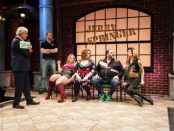
"Jerry Springer - The Opera" is not for opera purists nor is for people who are easily offended by four letter words and other bad language of which there is a multitude. However, its irreverence skewers social, religious and political hypocrisy. The New Group’s production directed by John Rando is one of the most exciting musical theater experiences to be currently obtained in New York. It actually seems more relevant in Trump America where this sort of thing is cable-fodder every night of the week. If you are a dedicated theatergoer, miss this show if you dare. [more]
Of the twelve soloists, several were outstanding. Tenor Scott Mello’s "Nigra Sum" was a virtuosic, romantically charged reveling in sensuality. The soprano duet, "Pulchra Es," with Molly Quinn and Melanie Russell, though it began a little shakily, finished well: as the two women’s voices came together in extremely difficult passages, the modernity of Monteverdi’s “secunda prattica,” or “newer style,” shone. [more]
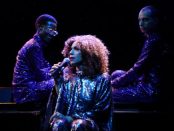
Thus begins the unique show, "Black Light," which is a concert cum confessional. In her sequenced gowns--and there are five costume changes during the 90-minute performance--and with her red lipstick and frizzy, frazzled, dark hair, Jones sometimes provides a strong, alto voice for her intermittent songs, ranging from ballads (“Crossroads”) to hard rock (“Life is motion”). [more]
"Candide"’s giddy overture was of course the euphoric opening number of the 92nd Street Y’s Lyrics & Lyricists Series: "Lenny’s Lyricists." This was a splendid concert celebrating Leonard Bernstein’s centennial by spotlighting his collaborators. The novelty here was that we watched footage of a close up of the hands of pianist Ray Wong as he superbly played via video projected onto a large screen as artistic director Rob Fisher turned the score’s pages. [more]
Equally exciting is Lorelei’s celebration of each of the ensemble’s individual voices. Peter Gilbert’s "Tsukimi (Moon Viewing)," commissioned by Lorelei and premiered in 2013, offers each of the nine singers a solo moment within the context of a complex choral work: a subtle Heian dynasty text celebrating anthropological and mythological reverence for the moon provides a splendid vehicle for the examination of each woman’s unique voice and gifts. [more]
“September” by Earth, Wind and Fire was gorgeously mashed up with Kool & The Gang’s “Celebration” and was the soaring opening number of The New York Pops’ exhilarating rhythm and blues concert, "Heart and Soul." The event celebrated African American History Month and Valentine’s Day. [more]
Presiding over the entire piece and working in close artistic collaboration with Keene was actor F. Murray Abraham; he read the King James Bible based narrative from Ascension’s commandingly high pulpit. He was magisterially marvelous: whether speaking the omniscient ancient story-tellers’ words or God’s own, Abraham contributed as much as Keene did to the movement, shape and coherence of the "King David" presentation. [more]
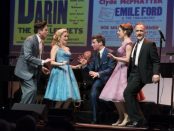
Whether bantering with the audience, displaying energetic dance moves, reciting factual details or performing Bobby Darin’s signature songs, the boyish Groff was sensational. “Splish Splash,” “Mack The Knife” and “If I Were a Carpenter” were all given galvanizing renditions. There was his soaring treatment of the emotional “Once in a Lifetime” near the end of the show. [more]
Along with some contemporary updating which always gets a laugh, Albert Bergeret’s direction is sharp and shrewd and his conducting of Sullivan’s sprightly and animated score is equally assured as well. The diction is crystal clear, a must for Gilbert’s intricate and clever lyrics. With an attractive and realistic setting by Albère and pleasingly color-coordinated costumes in blue, white and red (the colors of the Union Jack) by Gail J. Wofford, this is a delectable and entertaining revival for both those familiar with it and others discovering its pleasures for the first time. [more]
The set for the opera was itself a living, organic phenomenon; it functioned as an additional character in the opera. IONE sat near the moveable stage-flats; her back was to the audience, yet she was one of us. Hovering above the stage set were great canvas triangles – mildly billowed faluka sails – on which IONE projected Victorian and Edwardian era images of the British Empire in all its beauty and its ugliness. Priestess and manager, oracle and medium, IONE was at once a participant in the visual commentaries on Kitchener’s internal dramas and their director. [more]
Chen Yi’s music is, in the best possible sense, powerful: it affirms. Musicians and audience alike, at the end of each piece, are strengthened in the continuing determination to do one’s best. The evening’s concluding work, "Sparkle" (1992), a rugged, intricately disciplined wildness of both melody and rhythm, felt like an exposition of new ways of putting sounds together to create music, an immersion in how layering and linearity can coexist. The work’s sudden end – too soon and, simultaneously, at the only possible right moment – was gorgeously big and exciting [more]
The Tallis Scholars’ most recent turn in the Columbia University Miller Theatre Early Music Series was billed as “Heinrich Isaac at 500.” This concert title wasn’t quite accurate: the evening was a more like a bouquet of music by Isaac (c.1450-1517) and three contemporaries, Josquin des Prez (c. 1450-1521), Nicolas Gombert (c. 1495-1560) and John Browne (1453-c. 1500). – What a fabulous bouquet it was! [more]
Fairchild speaks well and communicates much with his physique, but his choreography is repetitive and uninventive. Here was a chance to breathe new life into a too familiar character. All Fairchild could come up with is lurching movements and awkward falls to the floor. He takes the obvious path to create his character with movement when he had a chance to illuminate the Monster’s inner emotions. [more]
Cohen then spoke; he presented the four-movement structure of the piece about to be performed. Although various passages in "Voyagers" evoked the diversity of music offerings on the Golden Record, highlighting “both the fragility and the power of human artistic expression,” the fairly traditionally structured piece was inspired by three main Golden Record offerings – what Cohen referred to as “source material” – a late Beethoven quartet, an Indian Raga and a Renaissance dance. "Voyagers"’ four movements are entitled Cavatina, Bhairavi, Galliard, and Beyond the Heliosphere. [more]
Playing both traditional and modern instruments, usually amplified, all four musicians supplement and expand Ukrainian folk melodies and songs with rhythmic and stylistic adaptations as well as other-culture borrowings from music from as far away as Australia, North Africa, North America and India as well as from other former Russian Empire provinces. The result, unexpectedly, is stunningly coherent. [more]