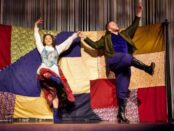
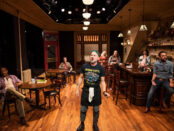
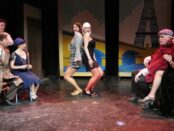
Despite its fairy-tale plot, Axemas isn’t really suitable for children because of language and sexual situations, but everyone else will find something amusing in this rag-taggle production. An Axemas Story could use some tightening and more professional looking scenery, but it’s tongue-in-cheek fun, nevertheless. The score is beautifully played under the musical direction of Sara Linger and the keyboard expertise of Buck McDaniel. [more]
"Killin’ Republicans," concept and libretto by Dick D. Zigun and music by Arturo Rodriquez, directed by vagabond, is billed as a rock opera about violence towards certain Republican Party leaders since the mid-nineteenth century. It deals with a series of assassinations and attempted assassinations of Republican leaders from the 1850s to President Reagan in 1981. It is supposed to be a discussion about the reasons for the attacks and not a call for violence against Republicans. The entire show is sung or performed in spoken form in various styles as more of a concept concert than an opera. The libretto covers a wide range of events attempting to give context to the multiple incidents but fails to clarify the point of the show. It is a mistake in its present form. [more]
"The Jerusalem Syndrome" is a pleasant new musical comedy with some fine clever songs and good comic moments. However, Don Stephenson’s production does not take the farcical elements far enough nor does he allow the cast to really have fun with their wacky roles. Playing this material mainly straight undercuts the inherent fun in the premise and plot as the Jerusalem syndrome is ripe for satire. [more]
Michael John LaChiusa’s "The Gardens of Anuncia" is an interesting attempt to tell choreographer Graciela Daniele’s adolescent story. Unfortunately, as of now the show does not make the case that her coming of age was that eventful or compelling. What we might like to know is about her famed career, but that sort of presentation has been done in "Fosse," "Jerome Robbins’ Broadway," and "Prince of Broadway," the Harold Prince story. "The Gardens of Anuncia" is pleasant enough but leaves one hungry for more. The magical realism elements might be more fleshed out and some of the unanswered questions that are coyly handled might be revealed. [more]
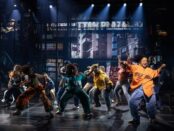
"Hell’s Kitchen" is both ambitious and noble in its intentions. However, as of now the show on the stage of The Newman at The Public Theater is not there yet. With very few characters developed and too many unanswered questions, the show’s book needs a simple rewrite. The Alicia Keys' score which too often sounds the same could use a reshaping to find some climactic moments other than the drama in the story. The plot lines need to come together more, rather than as disparate elements that take us in new directions all the time. Ultimately, Hell’s Kitchen has great potential when these problems are addressed. [more]
Director Matthew “Motl” Didner manages to make what might have been just a well-staged concert of moving songs into a dramatic whole with a deep feeling for the ebb and flow of emotions from happiness to hopelessness. "Amid Falling Walls"—an apt title, unfortunately, still consequential in 2023—does come during a spike in anti-Semitism. Though an entertainment, the show provides ample historical evidence of blind prejudice. If only the message could register. [more]
Milo Cramer’s delightful solo musical "School Pictures," part of a festival of new one person shows running in repertory at Playwrights Horizons, is wildly inventive, hilarious funny, and extremely insightful about adolescence, class, over-privilege and the New York education system. Almost entirely sung throughout, School Pictures tells us in a series of 11 songs about Cramer’s experiences working as a private tutor in NYC after school with mostly rich, brilliant students who are damaged by their parents – and their own – expectations. All of them hope to get into one of the eight elite specialized high schools for which they will need the SHSAT (Specialized High School Admissions Test) or top colleges and the competition as both the parents and students know is fierce. [more]
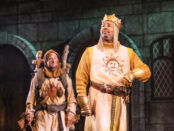
Still, whatever faint accommodations he grants it, for Idle, structure is the enemy of joy, which every aspect of "Spamalot" is relentlessly intent on delivering, not only from a few well-performed and well-known old Monty Python bits (the Knights Who Say "Ni!"; the French Taunter; the Black Knight) but also through amusing allusions to classic Broadway musicals that Aaron Sorkin was never given the chance to ruin. To be sure, it is fan service on a couple fronts, forming a Venn Diagram highlighting anyone who adores, for example, how Idle's brainy, irreverent silliness transforms Stephen Sondheim's song "Another Hundred People" from "Company" into a running plague count. It takes incredibly varied abilities to appealingly belt out Sondheim while landing that joke, which Ethan Slater, as the dejected Prince Herbert, does impressively and without remotely shortchanging either responsibility. [more]
The musical "Harmony," the lovechild of pop music greats Barry Manilow (music) and Bruce Sussman (lyrics and book), has opened at a time when anti-Semitism has peaked once again and lessons to the contrary are in short supply. Harmony’s dive into Nazi era anti-Semitism, though, may fall on deaf ears, but Harmony is also very much an entertainment, not a message show. Certainly, Manilow and Sussman couldn’t have predicted the “perfect timing” of this staging, the last in a long line of productions, most recently at the Museum of Jewish Heritage in April, 2022. The current iteration is basically that production with most of the cast intact and a classier, mirrored set by Beowulf Boritt. [more]
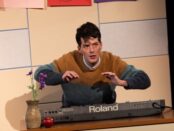
Olson might very well be the three-way love child of Thomas Dolby, Bill Irwin, and Max Headroom. He carries the show with an unbridled, infectious, childlike enthusiasm, sharing what he knows and loves--science and music--using songs he wrote in his car and lyrics that support his storytelling. He puts on this show like a life-long project that he couldn’t wait to find the barn for. Olson reels us all in as he fills our minds with profundities in the same ease and flair he might have if he were telling us an evening of dad jokes. He shares postulates about time, space, color, light, thought, consciousness, love, and existence, in easy-to-grasp terms using purposeful words and with exquisite imagery. [more]
How much you enjoy 'Gutenberg! The Musical!" likely depends on a combination of factors entirely unrelated to that German fellow: familiarity with the tropes it's skewering; your own level of disdain for such hackney execution; and your tolerance for Rannells and Gad's incessant mugging. In their first Broadway pairing since "The Book of Mormon" over a decade ago, Rannells and Gad are less a comic team than a comic rivalry, with neither willing to be the Abbott to the other's Costello. Fortunately, their ping-ponging, look-at-me dynamic only occasionally grows tiresome, usually when either of them is trying to gin up laughs that aren't there or shouldn't rise above a tee-hee. [more]
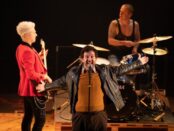
Melissa Etheridge is a bona-fide superstar. So, why is this artist, used to appearing in huge venues, “slumming” in a Broadway theater with a capacity of less than 800? Let’s not look this gift horse in the mouth. This is a gem of an opportunity to see Etheridge up close and personal in her My Window autobiographical show at the Circle in the Square. This is a memoir in song, songs that sprang from her adventurous life that went from entertaining in saloons to becoming a lesbian icon and a major rock concert star. [more]
nicHi douglas’ vision is one of evocative beauty, one that gives us stage pictures to treasure for some time. The seated women fanning themselves with beautiful white fans as they watch one of their own reading a passage or singing is a natural touch. Even the graphic for the show gives us pause – the word “pray” surrounded by two hands creating the parentheses denotes how personal the power of an individual’s prayer is. douglas’ church is almost utopian in its design in that it welcomes all with no judgment…even the “mixed company” of whites present at the service who might be startled by how genuinely euphoric the service is. Her choreography, like her direction, is empowered by a true spirit of celebration, reminiscent of the great Alvin Ailey masterwork, "Revelations." [more]
"The Picher Project" is a bluegrass and folk-infused musical conceived and directed by Quentin Madia, with music, book, and lyrics by Madia and Lauren Pelaia. This show is based on real-life events that are not only a part of Oklahoma's history but also of the social and industrial history of the United States. Through words and songs, the story is told of how this gentle, quiet, rural area became the center of lead and zinc mining in North America, only to end up dead as the number one most polluted place in the United States. [more]
"Saw The Musical: The Unauthorized Parody of Saw" begins with a picture perfect recreation of the disgusting bathroom from the first movie in the iconic horror franchise. Then the puppet (Billy) shows up, wishing us a hearty "Wilkommen, bienvenue, welcome." (Note: this review has spoilers for "Saw" the movie as well as "Saw The Musical.") The show is impressively done with a cast of three (with the exception of Detective Tapp, played via voiceover by Donnel Johnson). Danny Durr plays Gordon and Zepp, Adam Parbhoo plays Adam and Gordon's daughter Diana, and on opening night Gabrielle Goodman played Amanda, Ali and Jigsaw. Goodman in particular stands out with a lovely voice and excellent dance skills, but all three turn in solid performances. (Durr's wig is so good it deserves its own program credit.) [more]
It takes considerable skill for competent actors to play at being bad actors, and many of the cast members succeed. It is not a bad play, but the overarching problem with the show is that it is playing to a niche audience. If you do not know anything about the B-movies of the 50’s and 60’s, you will react as I did in thinking it is a terrible play. If you are familiar with the work of Roger Corman, William Castle, or any other B-film directors, or any of the films, such as "Galaxy of Terror," "The Little Shop of Horrors," "The Tingler," "The Curse of the Werewolf," or any of the dozen movies of that period, you may enjoy this production [more]
The 1968 musical 'Golden Rainbow" (the show that gave us the song sensation “I’ve Gotta Be Me”) was so identified with its stars Steve Lawrence and Edie Gormé that it has not been seen in 55 years. When it was suggested to composer Walter Marks that he revisit the show, he found it had so much material created specifically for the Lawrences that it was no longer revivable. Instead he has written a new version of the original book by the late Ernest Kinoy (his collaborator on the Broadway musical "Bajour") as well as five new songs. The results are a small but appealing musical comedy with a terrific jazzy score as directed and choreographed by Stuart Ross. [more]
Borelli as Doris Day is charming and appealing; her voice is not quite as strong as Day’s, but it is pretty and expressive, especially in quieter, more intimate moments. At the peak of some songs, where she’s expected to sing out fully and with passion, her voice doesn’t quite have the strength. [more]
In "Relapse" ’s most original conceit, a quartet called The Intrusive (Vinny Celerio, Audree Hedequist, Nicole Lamb and Zummy Mohammed) becomes a Greek Chorus, insinuating themselves into the minds of the four unhappy patients while commenting on the inner workings of their care. The four are nimble, vivid and sing well, choreographed by Freyani Patrice whose movements ooze, flit and crawl about the stage as these four surround each character. [more]
Visually, the show is not as effective as it might have been considering the play usually includes a great deal of magic. Here there is very little in the way of scenic illusions or legerdemain. Alexis Distler’s setting which makes use of some elements of the design for Hamlet, the previous staging on the Delacorte stage, a falling down mansion seemingly off its foundation, adds little to the production’s visuals. Except for the stunning harpy costume for Ariel by Wilberth Gonzalez, the rest of the designs are more than bland. The all-black leather creations for the Europeans give the production a contemporary look that feels out of place. The dozens of community partners dressed in matching blue and yellow outfits have been given little to do besides stand around as witnesses or hum to the large-scale musical numbers. [more]
While the misnamed "How to Steal an Election: A Dirty Politics Musical" is no lost masterpiece and at times seems long, it is a diverting political revue which offers an interesting take on the politics of the last 180 years. With the charming Jason Graae at the helm, the rest of the talented cast keeps the show rolling merrily along. New faces Emma Degerstedt, Alex Joseph Grayson, Courtney Arango, Kelly Berman and Drew Tanabe demonstrate that they should have very successful and acclaimed careers before them from their work here. [more]
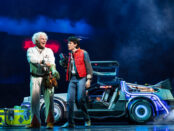
"Back to the Future: The Musical," the time travel adventure, joins a long line of problematic screen to stage musicalizations which do not improve on the originals in any way. Joining the list that includes in recent memory "Pretty Woman," "King Kong," "Tootsie," "Mrs. Doubtfire" and "Almost Famous," Back to the Future, using one of the original movie’s co-writers (Bob Gale without Robert Zemeckis), attempts to transplant the film in toto to the stage of the Winter Garden Theatre without adding anything new to the mix other than having the characters sing and dance. If theater is meant to surprise us, then like the stage version of "Almost Famous," "Back to the Future" slavishly follows its source material so that we feel like we have seen it all before – and better. [more]
The family-oriented TheaterWorksUSA’s latest musical adaptation of the best-selling children’s novels of Dev Pilkey is "Cat Kid Comic Club: The Musical," an exuberant colorful one hour irreverent entertainment for children of all ages. Written by Kevin Del Aguila (book and lyrics) and Brad Alexander (music) who previously wrote the highly successful "Dog Man: The Musical" from the earlier Pilkey series, "Cat Kid Comic Club" is surprisingly faithful to the book of the same name and will not disappoint its many fans. With clever and imaginative direction by Marlo Hunter and her design team which uses puppets as well as live actors, the hard-working cast of six (almost all of whom appeared in TheaterWorks’ "Dog Man" musical) play multiple roles to tell this hilarious and surprising story. [more]
"Here Lies Love" unreels like an MTV music video with the emotional content lost in the technique. The real issue of this musical is that it’s impossible to feel anything for the lead characters, with the possible exception of Estrella. They are moved about the extraordinarily gimmicky set like chess pieces with Imelda checkmating everybody. Jacobs evinces the boldness of Imelda, the script limiting her ability to show any tenderness or vulnerability. Llana's Ferdinand is written pretty much as a stolid symbol, hardly human at all. [more]
The Nazis persecuted not only Jews, political opponents and its own, but also homosexuals. Jews were forced to wear the infamous yellow stars; gays, the pink triangle. Alan Palmer, in his one-man show "Chanteuse" at HERE Arts Center, gives an intimate, heartbreaking look at one victim—fictional or not—that turns impersonal facts into passionate theater. [more]
Terri Hooley (a game, genial Glen Wallace) is both the main character and the narrator of "Good Vibrations: A Punk Rock Musical" at the sparkling Irish Arts Center. How he morphed from Terry to Terri is a bloody tale that opens the show, albeit with a bit of winking Irish humor. Written by Colin Carberry and Glenn Patterson, "Good Vibrations" takes place in the 1970’s in a Belfast rife with violence, at the height of the inter-religious disturbances in Northern Ireland called The Troubles and is based on the 2012 film of the same name (which they also wrote). Terri Hooley is a real person and Good Vibrations paints a mostly complimentary portrait of this man who was so important to the music scene in Belfast. [more]
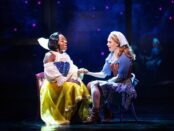
The only problem with Hartmere’s plot is that it remains undeveloped. None of the princesses get to read Friedan's book (there is initially only one copy) and they take it on faith that it offers them alternatives. The plot goes off on a series of tangents (Prince Charming’s assistant Prince Erudite the Celibate reveals that he is gay when he meets Snow White’s assistant Clumsy, the Cinderella’s Stepmother attempts to get the Narrator to choose one of her daughters for Prince Charming after Cinderella’s defection) but these narratives turn out as you would expect with no surprises. As staged by director/choreographer team Keene & Mari Madrid, whose credits up until now are mainly in film and music video, (creative consultant: British director: David Leveaux), the many production numbers look like aerobics for a rock video which may please Spears fans but look incongruous in a Broadway musical based on 18th and 19th century stories. Spears’ fans will be pleased that the show includes eight of her top ten hits: “Oops!... I Did It Again,” “Baby One More Time,” “Gimme More,” “Toxic,” “Circus,” “Lucky,” “Work Bitch,” and “Stronger,” almost all with lyrics tweaked by Hartmere to fit a story of princes and princesses. [more]
Press materials promise a work that is inspired by Kafka's "The Castle" and Melville's "Bartleby, the Scrivener." Both are name checked – the lead character is called K, played by a clear-voiced Zoe Siegel, and there is even a Bartleby (Austin Owens Kelly, doing triple duty on synthesizer and later acoustic guitar) who says "I prefer not to" very often – but "In Corpo" also owes something to Vaclav Havel's "The Memorandum" with its depiction of bureaucracy gone mad. Of course, not even Havel could have envisioned the tyranny of the complex password, something "In Corpo" uses to excellent comic effect. The show is at its best when it satirizes things that everyone has to deal with, such as passwords and inane tasks. [more]
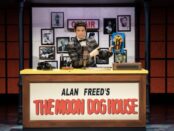
"Rock & Roll Man," the new jukebox/biographical musical at the New World Stages has a great deal going for it. The story of legendary Rock & Roll impresario Alan Freed is told in a series of delicious period songs with a few original works (by Gary Kupper who also cowrote the libretto with Larry Marshak and Rose Caiola) thrown in. The show is basically factual, although a tad exaggerated, and doesn’t shy away from Freed’s well-known issues such as his alcoholism and taking payola. Best of all, the cast is led by Constantine Maroulis in a complicated, fine-tuned and, for him, subdued performance. [more]
"The Gospel According to Heather," with book, music, and lyrics by Paul Gordon, is a story about a teenager's struggles with fitting in with her contemporaries, finding a boyfriend, and dealing with the supernatural powers which she seems to have acquired after finding a Roman coin in a fish. On the surface, this show appears to be a coming-of-age tale with music, but it is much more: it is a cleverly done and, at times, pointed commentary on the socio-political nature of contemporary America, and of religion. [more]
New York City Center Encores!’s new production of the musical, directed by Chay Yew, stars another Tony Award winner, the sensational Ruthie Ann Miles, as the determined Margaret Johnson with beautiful-voiced Anna Zavelson as a believably three-dimensional Clara. The Encores! production is more down-to-earth than either the film or the original Lincoln Center production and more satisfying as a human drama. There’s no stinting on humor, but the characters’ formerly trivial problems now seem more worthy of our attention. [more]
The show is a deft combination of action and humor with elements of horror. One of the production numbers, "Dissection Dance," is an homage to the "Time Warp" choreography of "The Rocky Horror Picture Show." The name of the high school, George R. Romero High School, invokes the zombie horror films he created. And with the ensemble's comedic timing, the show delivers an entertaining romp, with a feminist twist, through the psyche of three adolescent girls: Madison, Stella, and Grace. It needs a bigger stage and more actors but it is still an entertaining theatrical experience. [more]
Scheduled to run only until July 1, "Lizard Boy" deserves a longer life as one of the most satisfying musical theater offerings to be seen currently in New York. While the message of tolerance and diversity is not heavy, the theme is dramatized so that no one can mistake its intent. The three-person cast is superb in the acting, singing and musical departments. Brandon Ivie’s staging is clever and imaginative, while the book, music and lyrics by Justin Huertas make audience goers look forward to his next project with eager anticipation. [more]
Picking the easiest possible creative path, a decision the effort-averse George would no doubt admire, the McSmiths forgo imaginative risk-taking in favor of simply copying their source material, shaping "Singfeld!" as a parody musical about writing a parody musical. In other words, "Singfeld!" is also about nothing, which makes the entire endeavor feel, at times, akin to a Sartrean spiral or, as Jerry's archnemesis Newman (Jacob Millman) more bluntly puts it, "hackey." That's not to say there aren't some funny moments during "Singfeld!," but when humor is largely based on "remember when?," the comedic ceiling is right above your head. [more]
Lucas’ script remains faithful to Miller’s teleplay (with the excision of Joe’s delirium tremens in the psycho ward or his second hospitalization) and much of the dialogue is actually Miller’s. However, the problem is the score. Guettel’s 18 songs (including four reprises) are often atonal, unmelodic, unrhymed and don’t scan. While this is true of the Tony Award-winning "The Light in the Piazza" that score had such a lush sound that it was automatically romantic and appropriate for its story. Here it is almost as though Guettel is striving for opera but without the orchestral underpinnings to make it so. The lyrics are mostly recitative, abstract and metaphorical. Aside from three songs in which Joe or Kirsten are joined by their seven-year-old daughter Lila (played by Ella Dane Morgan), only the couple sing, with O’Hara given seven solos. The real problem is as Stephen Sondheim said about his musical Do I Hear a Waltz?: these are characters that wouldn’t sing so the only way to solve this is to have made "Days of Wine and Roses" an opera with a great deal of orchestral music. Here the songs do not add anything to the story. Like Marvin Hamlisch’s score for the stage version of "Sweet Smell of Success," Guettel’s music is devoid of atmosphere, period or otherwise, unless this is the fault of the orchestrations by Guettel with additional orchestrations by Jamie Lawrence. [more]
"New York, New York" is a big, jazzy show in the style of golden age musicals we have not seen for a while. While it removes the abusive relationship between Jimmy and Francine from the film, in doing so it waters down the story to a rather old-fashioned “newcomers make good in the big city” tale we have seen before. The theme of racism is handled rather simplistically, borrowing parts of the Lena Horne and Dorothy Dandridge stories. Characters seem to come and go and are often gone for too long a time. The new collaborations by Kander and Miranda are fun to hear but they do not come up to the standard of the Kander and Ebb songs that we know. The show becomes a showcase for the much loved songs “But the World Goes ‘Round” and “New York, New York” which are given pride of place. [more]
The music is well-done, with the songs fully integrated into the storyline and lyrics that help define essential elements of the character's nature and are filled with inside Star Trek references and jokes. For example, when Theerakulstit skillfully sings "Young," entirely in character as Kirk, we hear Kirk as an older man regretting getting old and no longer able to be the arrogant swashbuckling starship captain of his youth. When we meet Khan for the first time, Kropp sings “My Wrath,” which gives a history of how he came to be in this place and the reason for his extreme anger at Kirk. Although many of the references will be missed by a non-Star Trek audience, the songs are well-constructed, and more importantly, they are sung by a cast that knows how to sing on key and on pitch. While you may not leave the show humming a tune, they are the types of songs that one will return to without getting bored. [more]
The main issue with this show is the lack of clarity in the book. Who is the play about, the father or the son? Act I is primarily a story about Paul Sub and his business ventures leading up to the creation of The Coventry. Act II is more about Charlie Sub and how his father's business decisions impacted Charlie's life. In both cases, the story's elements need to be restructured to make it more compelling. Does it matter what type of romantic relationship Charlie develops in LA? Did Paul's liquor store fail after the robbery? The book needs to be edited to define clearly which story is being told and to eliminate the scenes that do not advance the story. [more]
When Mary-Mitchell Campbell’s baton brought out the first notes of the "Oliver!" overture from the Encores! Orchestra, the memorable tunes just flowed and didn’t stop until more than two hours later at the standing ovation and exit music. Lionel Bart’s score is rich in melody, the lyrics and the libretto evoking Dickens while still being theatrical. (The late William David Brohn did the lavish orchestral arrangements.) Lear deBessonet, the show’s director (and the Encores!’ artistic director) has fashioned a fast-moving evening filled with great performances starting with the sweet, fresh-faced Oliver of Benjamin Pajak and the incredibly talented ensemble of kids who gambol about with abandon. [more]
The latest collaboration by composer lyricist Albert M. Tapper and bookwriter Tony Sportiello, "On the Right Track," proves to be a charming chamber musical for three performers playing seven roles. The show combines realism with magic and the supernatural as it tells three stories which take place on a New Jersey Transit train. The Conductor, the narrator, also is a mystical figure who is able to give the characters second chances in life and lea them to a better place than when they came on board. Owing some inspiration to such classics as Sir James M. Barrie’s "Dear Brutus", Sutton Vane’s "Outward Bound" and Frank Capra’s "It’s a Wonderful Life," "On the Right Track" avoids being preachy at the same time that it offers suggestions about how to live one’s life. [more]
Unfortunately, though Sorkin may have made this "Camelot" more politically correct, scientifically accurate and less supernatural, it is much less entertaining and magical than earlier productions and certainly much darker as well as less funny. Whereas the original 1960 Broadway production billed itself as “the most beautiful show in the world,” Bartlett Sher’s revival has an almost empty grey stage most of the time (designed by Michael Yeargan) and drab costumes from Jennifer Moeller. Although the cast has 25 performers, the court scenes always look underpopulated as though not enough courtiers have shown up and there is almost no pageantry which one expects for a royal court of the Dark Ages or the Middle Ages. [more]
In addition to a surfeit of approximate rhymes, the score for Shucked includes a paean to corn and a reprise of the following ready-for-Hallmark advice: "maybe love is like a seed/a little sun is all you need." Meanwhile, Horn blithely salts the earth with acerbic observations about how "marriage is simply two people coming together to solve problems they didn't have before." Foregoing any accountability for this philosophical inconsistency, director Jack O'Brien instead attempts to cover for it with turbo-charged pacing that not only sacrifices thought for an admittedly infectious energy but also, as a part of this devil's bargain, undermines the comic timing necessary for a lot of Horn's jokes to land properly. But the amiable cast never falters, even when the laughs do or the score becomes more saccharine than corn syrup. The cast is adept, too, at executing Sarah O'Gleby's inventive choreography on scenic designer Scott Pask's ramshackle barn of a set. Particularly enchanting is a rolling barrel dance that Durand daringly pulls off with impressive grace. It's just too bad that this delightful surprise isn't accompanied by many others. [more]
Perhaps it’s the difficulty of finding dancers who can perform the intricate, body isolation moves so emblematic of Fosse’s very individual style, but to those who know and experienced his brilliance when he was hands on, this cast is a bit too clean cut and even-tempered. (The late Ann Reinking, a Fosse muse, was more successful staging her revival of "Chicago" still setting records on Broadway after moving from its New York City Center Encores! birthplace.) Nevertheless, Cilento is using a great deal of the original vignettes, excluding a few (most particularly Fosse’s perfectly ludicrous sexualizing of a ballet class) and adding more spoken lines, including an intermittent narration given by the charming, solid Manuel Herrera who also shows off his great dancing chops. [more]
Although the women grow up and change over the 26 years we see them, Heifner’s book tends to stay away from politics and the women’s movement other than mentioning markers like Kennedy, Nixon and Bob Dylan. However, the dialogue is bright and lively. The show is definitely a period piece ending as it does in 1990 but there are probably women who still live these lives. While in no way taking a feminist point of view, the characters do evolve and change over the years. [more]
Celebrating the 50th anniversary of its original film release, Pulitzer Prize-winning playwright Suzan-Lori Parks has turned "The Harder They Come," the cult Jamaican film that starred later reggae legend Jimmy Cliff, into an exuberant stage musical now at The Public Theater. Led by British stage star Natey Jones and American Caribbean actress Meecah, the large cast does full justice to the new score which includes the ten songs used in the movie plus 26 other Jamaican and traditional songs, additionally interpolated ones by Cliff and others, and some with additional lyrics by Parks. There are also three original songs by Parks herself who when she is not involved with one of her plays fronts her own rock band. [more]
The book of "Bad Cinderella" plays like a series of unfunny "Saturday Night Live" sketches. Laurence Connor (who also directed the earlier London production) has given the show no particular style and each scene seems to be in another genre. The show can’t decide if it is taking place now - with its references to rock band Guns N’ Roses (parodied in the song “Buns ‘n’ Roses”),its use of both diversity and inclusion, a female Vicar, its erotic baker, reference to a “spare” prince, and its shirtless muscle hunks seen in the palace gym – or the Middle Ages. [more]
While Brown's tunefully varied score strives to historically situate the bigoted nightmare we're witnessing within the cultural context of the South's fabricated sense of nobility and victimhood, an offensive postbellum myth known as The Lost Cause, Alfred Uhry's reductive book ham-fistedly narrows our attention, transitioning from a corrupt law-and-order procedural in the first act to a preposterously scripted search for the truth after the intermission. Although Dane Laffrey's unremarkably fungible from-courthouse-to-prison-to-gallows set overbrims with historical figures, most of them exist on a character believability spectrum somewhere between "My Cousin Vinny" and "Driving Miss Daisy" (also written by Uhry). If not for Sven Ortel's rear-wall historical projections of these real people, an audience might suspect at least a few of them were invented out of whole cloth. [more]
"Dear World," the not terribly successful 1969 Jerry Herman musical based on Jean Giraudoux’s "The Madwoman of Chaillot" (1945), was basically a vehicle for the brilliant Angela Lansbury. It needs a star to pull off its quirky inconsistency and New York City Center Encores! has a gem, Donna Murphy, who, though under-rehearsed due to a Covid scare and carrying her script, gives a colorful and moving performance as its central character, Countess Aurelia. [more]
The show is billed as a musical, but it is more concert than play, strong in music and weak in the storyline. The songs cover a lot of emotional ground, many with a humorous edge, but the book only provides a slim dramatic structure for the characters' actions. What is missing is more detail about who the characters are and for what reason we should care about the events being depicted. The dialogue is more of an introduction to the songs than a dramatic link to the overall story. [more]
Although British playwright Simon Stephens has written three musicals with composer/lyricist Mark Eitzel, formerly of the indie rock band American Music Club, Cornelia Street, set on a quiet back street in the West Village, is the first to arrive in New York where it is having its world premiere courtesy of Atlantic Theatre – Stage 2. Led by two-time Tony Award winner Norbert Leo Butz who is on stage almost throughout the show, "Cornelia Street," an elegy for a bygone age of unique Village restaurants and coffee houses, does not give its cast enough to do. The songs do not forward the plot but tell us what we already know, and the plot such as it is does not get going until the second half. An interesting attempt to create a place and its regular denizens on stage, "Cornelia Street" in this form does not make a satisfying statement. [more]
What is a mystery inside a riddle wrapped in an enigma? A Winston Churchill question from 1939 aptly fits a play with music set in 1924 that toys at being a murder mystery. As a play with music "Who Murdered Love?" doesn't work. As a play without music, it doesn't work as well. It is Dadaism with Surrealist overtones, and Surrealism with Dadaist overtones, if anyone in the audience knows what Dada or Surreal means. [more]
Unfortunately, this is musical comedy and does not need operatic voices, Lawrence being famously a singer with a very small range, while Kaye came from cabaret and night club. With all of the leads double cast, Sunday matinee’s singers seemed either miscast or poorly directed by Eric Lamp and Benjamin Spierman. Matthew Imhoff’s sets which are carried on and off by the singers took an inordinately long time and there were moments of dead time during office scenes which also seemed underpopulated. While conductor and artistic director Michael Spierman gave a creditable performance of the complete score, it did not seem to hang together but felt like individual numbers, unlike many other Weill scores which feel integrated and whole. [more]
Singer/songwriter Jill Sobule’s life story is on display in the charming cabaret musical "F*ck7thGrade" – with a difference. Sobule, the original “I Kissed a Girl” composer/lyricist, plays herself in this one-woman musical which features a band of three voicing other roles. The score is made up of her greatest hits plus four new songs. Since so many of her songs are autobiographical, they segue beautifully into the story of an unhappy childhood and later success as a performer and writer. Liza Birkenmeier’s book is based on months of interviews with some of the names changed while others are left intact. [more]
When the older Diamond reaches an existential breaking point, he finally stands up, stage center and takes command of his memories, experiences and his life with an intensely concentrated rendition of “I Am...I Said.” As sung by Mark Jacoby, it is the most poignant moment of the show, particularly when he confronts his younger self face-to-face. Will Swenson, the charismatic star of 'A Beautiful Noise," is hampered by the full-steam-ahead pacing of the show, leaving little time for introspection. He is a powerhouse, molding his voice to sound like the actual Neil Diamond as best he can, often missing the mark. But that’s okay because the majority of the audience came to feast on the songbook of a favorite performer and they are rewarded handily. [more]
Matthew López & Amber Ruffin (book) and Marc Shaiman & Scott Wittman (music and lyrics) have transformed the written-for-laughs film into a joyous musical, keeping much of the sharp wit of the original. Most importantly, they added heart and even a surprisingly contemporary spin or two, buoyed by the brilliance of Casey Nicholaw’s direction and choreography (although all those knee slides made me worry for the talented dancers’ health!) [more]
The York Theatre Company’s masthead reads “Where Musicals Come to Life…” and that couldn’t be more evident in their new production, "Hoagy Carmichael’s Stardust Road." Originally scheduled for a Fall 2015 run at London’s St. James Theatre (cancelled due to a key investor pulling out), then workshopped during a summer student production at Indiana University’s Department of Theatre, Drama and Contemporary Dance in 2018, the show finally arrives in a beautifully crafted production at York’s Theatre at St Jeans, deserving of an open-ended run or commercial transfer. Conceived by director Susan H. Schulman, choreographer Michael Lichtefeld and musical arranger Lawrence Yurman, and developed with Hoagy Bix Carmichael (Hoagy’s son), "Hoagy Carmichael’s Stardust Road" succeeds not by showing the audience another “And Then I Wrote” compendium, but by allowing the endless riches of the Carmichael songwriting catalogue to say it with music. We are treated to five extended “parts” where we meet seven characters, all friends, as they traverse the decades from the 1920’s to the 1950’s, through every high point and every heartache. [more]
Adopting the hokey framing device of a concert documentary, Kim turns the impending U.S. debut of a South Korean entertainment company's three hottest acts into a triptych of rigorously gendered plots. While attempting to capture all the glitz, glamor, and artistry, the American documentarian (Aubie Merrylees) also relentlessly stirs the pot to heighten any behind-the-scenes discord for the cameras, which doesn't make much sense since his paycheck is signed by Ruby (Jully Lee), the record label's iron-fisted founder and driving force, who obviously wants a glorified promotional video, not an investigative report. But to ascribe dramaturgical logic to the situation is to entirely miss the point. Aided by Peter Nigrini's voyeuristic projections of backstage squabbling, the objective is not truth but, rather, to establish the type of assiduously rendered false intimacy fans perceive as truth. [more]
The new production of "The Sound of Music" at New Jersey’s Paper Mill Playhouse is such an utter delight, you shouldn’t be wasting time reading this review, you should be ordering tickets right now (www.papermill.org). I’ve seen countless productions at Paper Mill since the 1970’s. This production, running through January 1st, is one of the most satisfying productions I’ve ever seen at that theater—which is saying plenty. Director Mark S. Hoebee tells the familiar story—rich with honest sentiment--clearly and well. The show, with more than 30 actors on stage and 16 musicians in the pit, is handsomely produced. [more]
The cast is a combination of New York stage favorites (Stark Sands, "Kinky Boots," and Betsy Wolfe, "Waitress," "Falsettos" and "The Mystery of Edwin Drood"), new faces (Lorna Courtney, Ben Jackson Walker, Justin David Sullivan) and older veterans (opera baritone Paolo Szot and London stage star Melanie La Barrie making her Broadway debut.) The clever book is by writer David West Read previously seen in New York with "The Performers" and "The Dream of the Burning Boy" as well as the long running television series Schitt’s Creek. The show seems to have been influenced by "Something Rotten"(parody of Elizabethan times), "Six "(its updated 16th century costumes by Paloma Young), "Head Over Heels" (reboot of a classic tale wedded to a pop-rock score) and "Moulin Rouge" (the over-the-top staging by director Luke Sheppard and choreographer Jennifer Weber) – but is actually more fun than all of those shows. At times it resembles "Saturday Night Live" skits but knows enough to keep them short and not let any of them go on too long before introducing the next complication. [more]
"Kimberly Akimbo," David Lindsay-Abaire’s oddball take on the title character’s dishearteningly sad disease, began life as a play back in 2001, reaching New York via the Manhattan Theatre Club in 2003. In 2021 Lindsay-Abaire (libretto and lyrics) combined resources with the eloquent composer, Jeanine Tesori, to restyle the play as an award-winning musical produced at the Atlantic Theater Company in November 2021. This is the production that has moved to the Booth Theatre where it now resides featuring the glowing performance of Victoria Clark as the troubled title character. Jessica Stone repeats her directorial duties, managing the move to a larger venue with skill and subtlety. [more]