
News Ticker

Scott Bakula

The Baker’s Wife

December 17, 2025

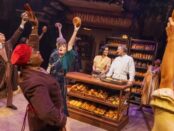
Greenberg’s greatest achievement is his refusal to inflate or apologize for the material. He treats "The Baker’s Wife" as what it is: a musical of sensibility rather than momentum, concerned with romance, regret, and the cost of impulsive desire. There is a deliciously vaudevillian, music-hall bustle to “Bread,” the ensemble number that marks the village’s first ecstatic encounter with Aimable’s handiwork. The song clatters and skips with comic precision, its rhythms suggesting both hunger and sudden abundance, and Stephanie Klemons’ dances here leans into that sense of organized chaos, shaping the townspeople’s delight into a playful choreography of anticipation, consumption, and communal relief. Paul’s dynamic rendition of “Proud Lady,” with its Brel-inflected toughness, certainly gets its desired effect. In revealing the show’s emotional coherence, Greenberg demonstrates that The Baker’s Wife was never broken beyond repair—only misunderstood. Here, at last, it feels whole. [more]
Anyone Can Whistle

March 20, 2022

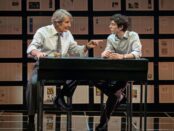
Although when MasterVoices chose the third of the four Stephen Sondheim/Arthur Laurents collaborations, "Anyone Can Whistle," as part of their 80th season at Carnegie Hall, they had no way of knowing that it would prove to be a memorial to the late Mr. Sondheim rather than a tribute. This rarely revived show, now considered a “cult classic,” a euphemism for a quick flop in 1964 running only nine performances, was ahead of its time, attempting a new form, one that Sondheim has called “the first absurdist musical.” Performed by stars Vanessa Williams, Santino Fontana, Elizabeth Stanley, Douglas Sills, Eddie Cooper, Michael Mulheren, and Joanna Gleason as the narrator, it was beautifully sung under the direction of maestro Ted Sperling, but can’t hide the fact that Laurents’ libretto is extremely scattershot taking on far too many targets for one show. Subtitled “A Musical Fable” in its first publication, the musical is really a cartoon satirizing everything imaginable. The theme is one of individualism versus conformity, a big trope for shows and movies in the turbulent 1960’s, now symbolized by the more famous "King of Hearts" (1966), "Your Own Thing" (1968), "HAIR" (1968) and "Easy Rider" (1969). [more]